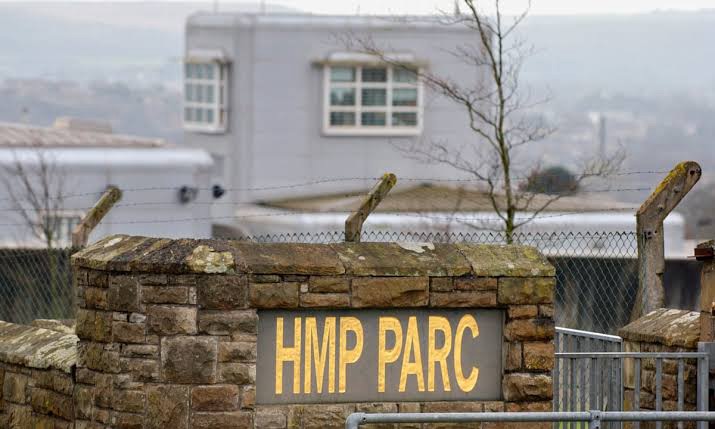
© Tom Blewitt & Zack Griffiths – HMP Prisons Justice Group
HMP Parc: A System in Freefall — And Why the HMIP Review Makes the Case for Removing G4S
The latest HM Inspectorate of Prisons (HMIP) Independent Review of Progress at HMP Parc is more than a catalogue of operational failures. It is a damning indictment of the private management model that has governed the prison for over two decades. The January 2026 review exposes a facility where safety, decency, rehabilitation, and public protection have collapsed — and where the private operator, G4S, has repeatedly failed to bring the prison back under control.
This article examines the report’s findings through a critical lens and sets out the case for why the government must now remove G4S from HMP Parc.
A Regime in Ruins — Evidence of Structural Mismanagement
The review confirms that Parc’s daily regime is barely functioning. Prisoners are locked in their cells for excessive periods, with little access to education, work, or rehabilitative programmes. This is not a temporary blip — it is the result of long-term structural mismanagement.
A private operator is contracted — and paid — to deliver a stable, functioning regime. Parc’s regime has been collapsing for years, and G4S has failed to:
- Recruit and retain sufficient staff
- Manage vetting processes effectively
- Maintain a predictable, safe daily structure
- Provide the rehabilitative activity required of a resettlement prison
When a prison cannot even keep its regime running, it is not meeting the basic terms of its contract. This is not a staffing issue alone — it is a failure of leadership, planning, and oversight by G4S.
Chronic Staffing Crisis — A Predictable Failure, Not an Accident
HMIP highlights severe staffing shortages, high turnover, and an inability to retain experienced officers. This has crippled the prison’s ability to operate safely.
Does this justifies removing G4S?
Staffing is the responsibility of the operator. G4S has had years to stabilise its workforce and has failed repeatedly. The consequences are visible:
- Prisoners locked up for most of the day
- Increased violence and tension
- Reduced access to healthcare and external appointments
- A regime that collapses whenever staff are diverted
A private company that cannot maintain a safe staffing model is not fit to run a prison. Parc’s staffing crisis is not an unavoidable national trend — it is a direct result of G4S’s cost‑driven operating model, which relies on low pay, high turnover, and minimal investment in staff development.
Public Protection Failures — A Direct Risk to the Community
The review exposes serious weaknesses in public protection processes, including:
- Delays in sentence progression
- Insufficient access to offending behaviour programmes
- Poor risk management
- Inadequate preparation for release
Why this justifies removing G4S
Public protection is not optional — it is the core purpose of imprisonment. When a prison fails to manage risk, the consequences extend beyond the walls. G4S has allowed a situation where:
- High‑risk prisoners are released without proper intervention
- Risk assessments are incomplete or delayed
- The community is exposed to preventable harm
This is not just operational failure — it is public endangerment. A private company that cannot guarantee public safety has no place running a prison.
Drug Harm as a Symptom of Institutional Collapse
While the review notes attempts to reduce drug ingress, it also makes clear that Parc’s drug problem is rooted in deeper dysfunction:
- Excessive lock‑up
- Lack of purposeful activity
- Weak staff presence
- Poor living conditions
Why this justifies removing G4S
Drug harm at Parc has been catastrophic, with multiple deaths in recent years. G4S has presided over:
- A prison where drugs became widespread
- A culture of instability and fear
- A failure to address the root causes of drug demand
Even where supply routes have been disrupted, the underlying conditions remain unchanged. This is not progress — it is firefighting. A prison operator that allows drug harm to escalate to this level has failed in its most basic duty of care.
Leadership Effort Is Not the Same as Leadership Success
HMIP acknowledges that leaders are “trying,” but effort is irrelevant when outcomes remain so poor. Parc continues to operate in a state of crisis.
Why this justifies removing G4S
A private operator is not judged on effort — it is judged on results. G4S has had:
- Years of warnings
- Multiple critical inspections
- Repeated opportunities to stabilise the prison
Yet the same failures persist. Leadership that cannot deliver improvement after years of decline is leadership that must be replaced.
A Prison Still Haunted by Deaths, Violence, and Decline
The review cannot be separated from Parc’s recent history:
- A series of drug‑related deaths
- Two years of severe instability
- Violence linked to frustration and boredom
- A regime that left prisoners hungry and locked up
Why this justifies removing G4S
These are not isolated incidents — they are the predictable outcomes of a failing private model. Parc has become a case study in what happens when profit is prioritised over safety, rehabilitation, and human dignity.
The government cannot continue to allow a private company to run a prison where:
- People die preventable deaths
- Violence is fuelled by mismanagement
- Rehabilitation is impossible
- Public protection is compromised
This is not a prison in recovery — it is a prison in freefall.
The Case for Removing G4S
The HMIP review provides clear, evidence‑based justification for ending G4S’s contract at HMP Parc. The failures identified are not minor, not temporary, and not fixable under the current model.
The justification is clear:
- Operational failure: The regime is collapsing.
- Safety failure: Violence, instability, and drug harm persist.
- Rehabilitation failure: Prisoners cannot progress or prepare for release.
- Public protection failure: Risk management is dangerously inadequate.
- Contractual failure: G4S has not delivered the service it is paid for.
- Moral failure: Lives have been lost under their watch.
A prison that cannot meet its basic obligations cannot remain in private hands.
Conclusion: The HMIP Review Is a Mandate for Change
The 2026 HMIP review of HMP Parc is not just a warning — it is a mandate. The failures identified are systemic, long‑standing, and inseparable from the private management model that governs the prison.
G4S has had years to fix Parc. They have failed.
The cost of that failure has been paid by prisoners, families, staff, and the public.
After 43 deaths at PARC – scandal after scandal – and appauling and disgraceful reports – It is now time for the government to remove G4S from HMP Parc and return the prison to public control!
 HMP Prisons Justice Group