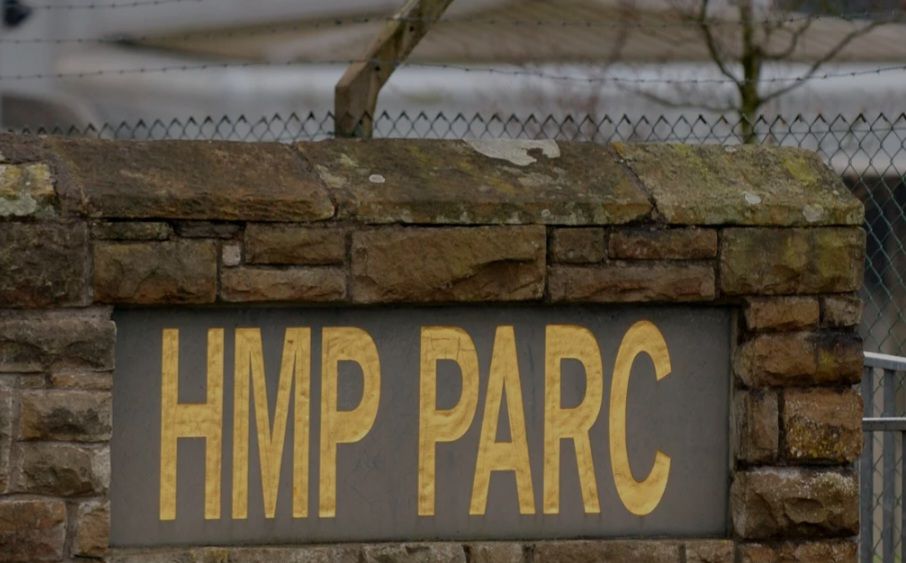
© Zack Griffiths & Tom Blewitt- HMP Prisons Justice Group
The state of the prison estate in England and Wales is deteriorating — and nowhere is this more starkly illustrated than at HMP Parc in Bridgend. Once hailed as a model of rehabilitation, Parc has in recent years been the scene of serious failures in safety, governance and regime delivery. Official inspection data and independent reporting show that the prison is now operating at a level far below standards required for decency, security and rehabilitation.
Key statistics & failings at Parc
An inspection in early 2025 found 894 drug finds in the year to 2024 at Parc — more than any comparable institution.
More than half of prisoners (70 % on A- and B-wings) reported that it was “easy to get drugs” inside the prison.
Self-harm incidents were recorded to have risen by approximately 60 % since the prior inspection.
Deaths at the prison reached at least 17 inmates in 2024, the highest number in England & Wales for that year.
According to the Wales Governance Centre, at Parc: assaults on staff increased by 109 %, self-harm incidents by 113 %, and self-harm requiring hospital treatment by 190 %.
In August 2024 the population was around 1,805 prisoners.
The most recent inspection report by HM Inspectorate of Prisons (HMIP) declared: “Previously judged… to be one of the most successful prisons… HMP Parc had suffered a serious decline in standards.”
What this tells us??
These statistics point to a prison that is overwhelmed:
Security failures – The staggering number of drug finds and the ease of access to drugs raise serious questions about perimeter control, staff contraband oversight and internal intelligence.
Violence and self-harm – The double-digit rises in assaults and self-harm point to a regime losing grip. The regime instability is also linked to long lock-up hours, boredom and lack of purposeful activity.
Regime inactivity and idle time – The hearing from the inspection: some prisoners being locked up for up to 21 hours a day, with limited access to education or purposeful activity.
Governance turbulence – The problems have been traced back to leadership, contract changeovers and high staff turnover. The HMIP report states the transition to a new management contract “fundamentally destabilised the prison”.
Scale and pressure – Being one of the largest prisons in Wales and privately run adds complexity and risk.
Why it matters
The failings at Parc are not simply localised—they reflect systemic risk:
Safety failures threaten both staff and prisoner welfare and erode public confidence in the prison system.
Poor regime and rehabilitation efforts reduce the chance of reducing re-offending, undermining one of the core purposes of imprisonment.
Private sector management combined with the scale of problems may expose contract and oversight models to real stress.
Given that Parc houses a high proportion of Welsh-domiciled prisoners, the consequences bear directly on communities across South Wales.
Steps for reform and repair
Based on inspection commentary and specialist analysis, key interventions should include:
1. Strengthen security and contraband control – invest in perimeter/drones detection, staff screening and intelligence-led searches. The inspection identified drone deliveries and weakness in gate security.
2. Regime stability and increased activity – ensure prisoners have meaningful hours out of cell, work, education and structured pathways rather than long lock-up periods.
3. Staffing, training and leadership – stabilise leadership, reduce turnover, improve morale and ensure staff are supported, accountable and able to perform effectively.
4. Healthcare and drug strategy – integrate clinical services, mental health support and a robust substance misuse framework, given the number of deaths and drug finds.
5. Transparent oversight and contract accountability – given the private nature of the prison and scale of failures, ensure contract-holders are held to account, with independent inspection feeding into real contractual consequences.
6. Focus on rehabilitation and resettlement – with high numbers of Welsh prisoners there, effective pre-release planning, vocational training and community links are vital to break the cycle of re-offending.
OUR ASSESSMENT
The inspection findings at HMP Parc are a wake-up call. The fall from being once regarded as “good” or “exceptional” (as earlier reports have shown) to being one of the worst performing prisons in the Welsh & English estate shows how quickly custodial standards can deteriorate when pressure on the system, leadership and resources combine. Unless swift, sustained and well-monitored action is taken, the consequences will be felt not only inside the prison walls but across communities, justice outcomes and public safety.
 HMP Prisons Justice Group